← Notes · Series C/D · beside Robot bill · Customer of record
Research note · Machine Agency · Pressure Test · claim-labeled
What a machine paying its electric bill would actually require
FACT ANALYSIS HYPOTHESIS open
The slogan “a machine pays its own electric bill” sounds like agency. Retail electricity settlement is an institutional stack: meter → utility customer information system (CIS) account → legal person on a tariff → payment rail → recognized settlement. This note pressure-tests the slogan against that stack. It is not a legal opinion, not a product, and not a claim that machines should become customers.
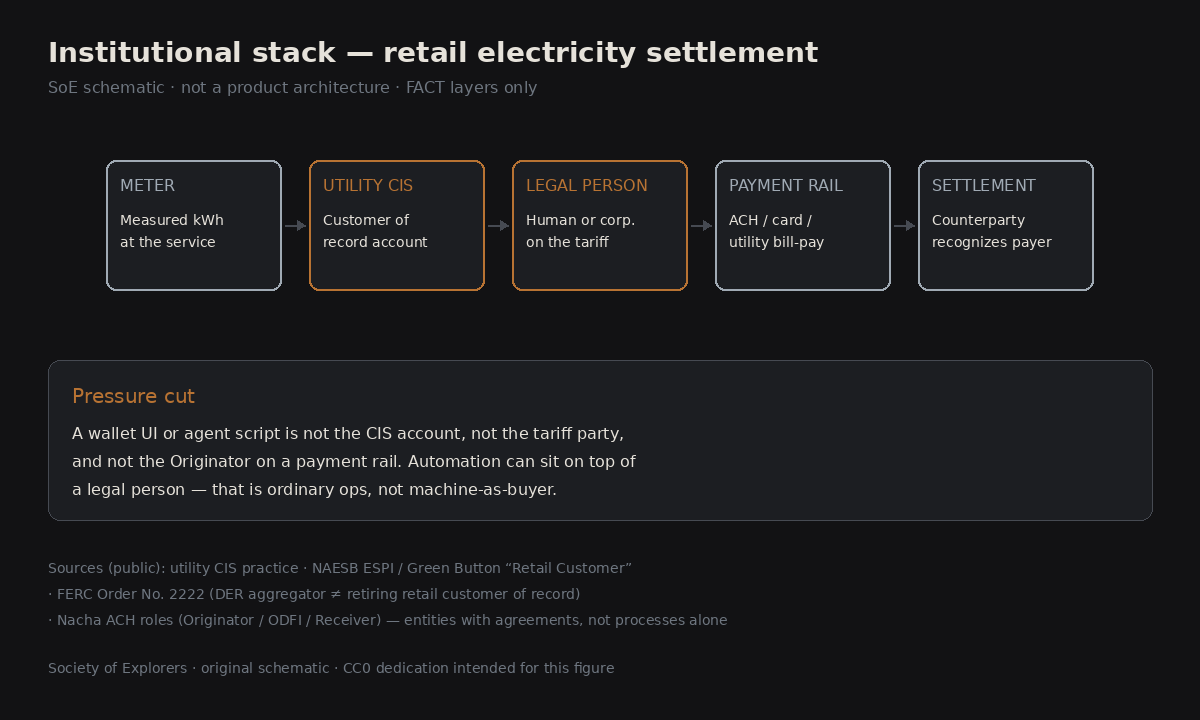
1. Slogan ≠ settlement
FACT Retail electricity is delivered, metered, billed, and settled under utility and retail-regulatory rules that name a customer on an account. Ordinary bill pay — card rails, ACH, utility bill-pay portals, enterprise APIs — already moves money for those accounts. That is current practice, restated; this note does not survey every jurisdiction.
ANALYSIS A screen that shows a balance, a wallet address, or an agent log is not, by itself, the sentence the meter and the CIS already use. The exhibition already holds that cut on Customer of record. This page adds the institutional layers that make the cut concrete.
2. Who “Retail Customer” already means
FACT The Green Button / NAESB Energy Services Provider Interface (ESPI) model — facilitated in the U.S. with NIST involvement — names three roles: Data Custodian (typically the utility holding usage data), Retail Customer (the residential, commercial, or industrial account holder), and Third Party (authorized to receive data after customer authorization). See NIST’s Green Button Initiative summary and the Green Button Alliance technical glossary.
ANALYSIS Machine-readable energy data exists. Authorization still points at the Retail Customer — the account holder — not at a process ID alone. An agent that downloads Green Button data under a corporate login is automation on a legal person’s authorization, not a new retail party.
3. Who counts the usage
FACT In Texas, 16 TAC §25.124(c) lets a customer ask the electric utility to test the meter. The PUCT substantive-rule PDF, fetched 2026-10-07, prints an effective date of 06/11/98 and says the utility shall test the accuracy of the customer’s meter on request. The test is scheduled so the customer, or the customer’s authorized representative, can observe it if they want. After the test, the utility shall promptly advise the customer of the date the meter was removed, the date of the test, the result, and who made the test. The test in (c)(1) is at no charge. A later request inside four years still gets a test; if the meter is within ANSI accuracy standards, the utility may charge a fee set in its tariff.
FACT On metered API usage, the billing pages fetched 2026-10-07 send a question about the charge to the company that sold the usage. OpenAI help article 7242625 tells a reader to reach OpenAI Support for unrecognized charges, subscription issues, refunds, or credit purchases that are billing related. The article says OpenAI’s team can investigate and review refund eligibility, and it tells the reader to contact their bank if they believe the charge is unauthorized. If a payment dispute is already open, the article says OpenAI cannot issue a separate refund while that dispute is active or after the bank has returned the funds. Prepaid API article 8264644 says purchased credits expire after one year, that OpenAI cannot extend that date, and that credits are non-refundable unless required by law or contract, or an approved exception applies. A reader who thinks an exception applies is told to contact OpenAI Support for a review. If a payment is disputed or refunded, credits equivalent to that amount are removed. Anthropic help article 8977456 (page date August 19, 2026) says all credit purchases are non-refundable. Google’s billing-adjustment page (Cloud Billing answer 13758070) says a credit, debit, or refund is requested by opening a case with Cloud Billing Support, and that “All BMods are subject to approval.” That page is addressed to the person filing for a customer. Gemini API billing (docs/billing) says unused Prepay credits expire after 12 months and are non-refundable, except after switching to a Postpay account. A switch that meets the page’s criteria refunds the remaining prepaid credits. Closing the Prepay account for any other reason forfeits them.
FACT As of October 2026, a search of the ISO catalogue, of NIST publication listings, and of the ANSI webstore for a published accuracy requirement on billed large-language-model tokens returned no such ANSI, ISO, or NIST standard. The queries were billed LLM-token accuracy on the ISO catalogue, LLM token metering accuracy on NIST, and large-language-model token metering accuracy on the ANSI webstore. IEEE P4180, “Standard for Requirements for Token Lifecycle Trustworthiness in Large Language Model Inference,” is an Active PAR, with PAR approval dated 2026-09-25. The same IEEE page lists no active standard. An Active PAR authorizes a working group to write a standard.
ANALYSIS Opinion: for metered API usage, the provider both counts the usage and decides a dispute about that usage, on the paths these pages actually publish. OpenAI’s review sits with OpenAI Support. Google’s billing modification waits on Cloud Billing Support’s approval. Anthropic’s article makes the credit purchase non-refundable. The page fetched on 2026-10-07 states no further dispute procedure. A card-issuing bank can still take a payment dispute. OpenAI’s article says to tell Support when one is already open. The Texas rule is a different arrangement: the customer can ask for a meter test, watch it, and be told who made the test. That comparison is an opinion. It settles no token count.
4. Wholesale participation does not retire the retail account
FACT FERC Order No. 2222 (2020) requires RTO/ISO tariffs that allow distributed energy resource (DER) aggregators to participate in organized wholesale markets, with coordination among the RTO/ISO, the aggregator, the distribution utility, and relevant electric retail regulatory authorities. FERC’s public explainer states that many DER owners remain retail end users buying from a utility while also participating in an aggregation that sells into wholesale markets. The aggregator — not each device — is typically the direct wholesale market participant.
ANALYSIS Order 2222 is about removing barriers to DER aggregations in wholesale markets. It is not a finding that software agents become retail customers of record, and it is not a finding that retail liability disappears. Wholesale participation and retail settlement are different sentences.
5. Payment rails name entities with agreements
FACT In the Nacha ACH Network model, an Originator is a consumer, business, or other entity that initiates entries under an arrangement with a Receiver; an ODFI is the financial institution that binds Originators to the Nacha Rules and forwards entries; a Receiver is a natural person or organization that has authorized entries to its account. Public Nacha developer guidance and Originator essentials materials describe authorization, SEC codes, and ODFI agreements — institutional roles, not anonymous scripts.
FACT Who can still stop an in-flight payment depends on the rail. It is not one generic “revoke.” For a wire or other UCC Article 4A credit transfer, the sender may cancel before the receiving bank accepts the payment order; after acceptance, cancel needs the receiving bank’s agreement or a funds-transfer system rule (UCC § 4A-211, fetched 2026-10-05). Article 4A does not apply to a funds transfer any part of which is governed by the Electronic Fund Transfer Act (UCC § 4A-108) — so consumer EFTA paths are not that cancel clock. For a consumer ACH debit, Regulation E lets the consumer stop payment by notifying the account-holding institution at least three business days before the scheduled date (12 CFR 1005.10(c)). For ACH debit stop-payment at the RDFI, public Nacha materials require the Receiver’s order to arrive with a reasonable opportunity for the RDFI to act before it acts on the entry (Nacha Minor Rules Topics; Nacha Ops Bulletin #3-2024 cites Section 3.7.1). A written non-consumer stop’s minimum effective period is described in Nacha Subsection 3.7.2.1 as quoted by EPCOR — the full official Nacha Rules PDF was not opened this run.
ANALYSIS An agent that “pays” by triggering ACH or card rails still settles through Originator / merchant / utility-account relationships that attach to legal persons and regulated institutions. Calling the script the payer confuses the UI with the counterparty the rail recognizes. A software revoke after the rail’s point of no return is a record and a dispute path — not proof the bank transfer reversed.
ANALYSIS When an agent sends the payment order, the software is not the UCC “person” the company entrusted with payment-order duties; the people who configured or control the payment-capable agent are.
6. What “pays” usually means today
FACT Large flexible loads — including data centers — already appear in utility planning and national electricity accounting as facilities and sectors, not as autonomous legal persons. Lawrence Berkeley National Laboratory’s United States Data Center Energy Usage Report: 2025 Update (LBNL-2001758; DOE-supported) estimates U.S. data center electricity use at 192 TWh in 2024 (4.7% of U.S. electricity consumption), with a Reference Case of 649 TWh (11.8%) in 2030 and a compounded uncertainty range of 521–843 TWh (9.5–15.3%). Those are facility-class energy estimates — not per-query myths, and not a claim about who the CIS account names.
ANALYSIS Load growth can be material while settlement remains institutional. Watts and agency are related; they are not the same claim. See also Power as a Primitive.
HYPOTHESIS Most public demos of “machine pays for power” will continue to be costume in the exhibition sense: automation, APIs, or a token ticker glued onto a corporate utility account and ordinary rails — unless a jurisdiction creates a recognized non-human customer-of-record path with liability, interconnection, and payment recognition attached. Hypothesis, not a shipping plan.
7. Institutional checklist (pressure test)
ANALYSIS For the slogan to mean machine-as-buyer rather than automation-on-behalf-of-a-person, each layer would need a recognized answer — not a mock UI:
- Meter / service point — which interconnection and protective limits apply?
- Usage count — who measured the number, and who answers if the customer challenges it? The Texas meter test and the API billing pages are in Who counts the usage.
- CIS / customer of record — whose name does the utility account carry?
- Tariff / retail regulator — who is liable for payment, deposits, disconnection, and theft-of-service rules?
- Payment Originator — which legal person holds the ODFI / merchant / bill-pay relationship?
- Data authorization — who is the Retail Customer authorizing Green Button / ESPI sharing?
- If wholesale DERs are involved — who is the aggregator under Order 2222 coordination rules?
- Vetoes — which human institution can pause, override, or disconnect (see Electronic Governor)?
open Whether any jurisdiction will create a non-human retail customer-of-record category with those layers intact stays open. This note does not lobby for one.
What would make this wrong
- Wrong if a jurisdiction’s published retail rules already treat a non-human process ID — without a legal-person shell — as customer of record and payment Originator, and this note failed to register that. Cite the tariff and CIS practice; correction welcome.
- Wrong if a software agent that sends the payment order is read as the UCC “person” entrusted with payment-order duties. The people who configured or control the payment-capable agent are. This note is not a loss-allocation holding.
- Wrong if “Order 2222 exists” is read here as “machines are wholesale customers.” The order addresses DER aggregators and coordination; it does not, on FERC’s public explainer, retire retail end-user status for participating DER owners.
- Wrong if Green Button / ESPI “Retail Customer” is read as meaning any software agent. The public glossaries define Retail Customer as the account holder.
- Wrong if LBNL’s 192 TWh / 4.7% (2024) or 2030 scenario band is treated as a SoE forecast, a per-query energy claim, or proof of machine agency. They are cited facility-class estimates from LBNL’s 2025 Update.
- Wrong if “costume” is read as a census of projects or a moral verdict on automation. It is an exhibition label for ticker-on-solved-problem, already used on the robot-bill and ledger notes.
- Wrong if this page is read as predicting machines will — or will not — become buyers by a date. No timetable is claimed.
- Wrong if every ACH movement is labeled a UCC 4A cancel clock. Article 4A excludes EFTA-governed transfers; debit stop-payment is a different sentence from credit-transfer cancel.
- Wrong if a UI “Revoked” after receiving-bank acceptance is read as proof the credit transfer reversed.
- Wrong if the opinion that a provider counts metered API usage and decides the usage dispute on its own pages is read as a finding that a bank, a card network, or a court has no role, or as a finding that a token count was wrong. OpenAI’s article leaves the bank dispute in place. The Texas sentence is §25.124(c) only.
- Wrong if IEEE P4180 is read as a finished accuracy tolerance. The IEEE page lists an Active PAR approved 2026-09-25 and no active standard.
- Wrong if the October 2026 search is read as proof that no standard exists outside ANSI, ISO, and NIST, or outside the queries named in Who counts the usage.
Sources (citeable, public)
- NIST — Green Button Initiative (ESPI / NIST facilitation overview).
- Green Button Alliance — Technical Info (Data Custodian / Retail Customer / Third Party glossary).
- FERC — Order No. 2222 Explainer; Order No. 2222 final rule (Docket RM18-9-000).
- Nacha — How ACH Works (Originator / ODFI / Receiver roles).
- UCC — § 4A-211 (cancel before receiving-bank acceptance); § 4A-108 (EFTA exclusion).
- CFPB — 12 CFR 1005.10(c) (consumer stop-payment).
- Nacha — Minor Rules Topics; Ops Bulletin #3-2024 (cites § 3.7.1).
- LBNL / DOE — Smith et al., United States Data Center Energy Usage Report: 2025 Update (LBNL-2001758; DOI 10.71468/P1RP4F); also linked via energy.gov.
- PUCT — 16 TAC §25.124 (meter test on customer request; PDF effective date 06/11/98; fetched 2026-10-07).
- OpenAI Help Center — article 7242625 (billing-related charges go to Support; a bank dispute stays available); article 8264644 (prepaid credits; fetched 2026-10-07).
- Anthropic — help article 8977456 (credit purchases non-refundable; page date August 19, 2026).
- Google — Cloud Billing answer 13758070 (billing modifications through Cloud Billing Support; “All BMods are subject to approval”); Gemini API billing (Prepay credits; fetched 2026-10-07).
- IEEE SA — P4180 (Active PAR, approval 2026-09-25; no active standard listed; fetched 2026-10-07).
Where criticism belongs
If a published tariff, CIS practice, or retail rule already names a non-human as customer of record and payment party without a legal-person shell, that is the correction. Pushback preferred over applause. Research intake is not open.
Continue this idea
If the wallet is not the CIS account, what must stay human-accountable?
Also Ledger earns its keep · Electronic Governor · Power as a Primitive. Nothing here is a signup.