← Notes · Series B · beside Electronic Governor · Physics still vetoes · pairs Pilot 2
Research note · Governors & Vetoes · Pressure Test · claim-labeled
What a governor means when intelligence becomes infrastructure
FACT ANALYSIS HYPOTHESIS open
When people say “governor,” they often mean either an automatic feedback loop or a human stop. Those are related sentences, not the same one. This note pressure-tests the Watt metaphor against modern stops: setpoint, envelope, and who holds the veto. It pairs the Series B film lane (Pilot 2). It is not a product, not a control-room procedure, and not a claim that AI already dispatches the bulk power system.
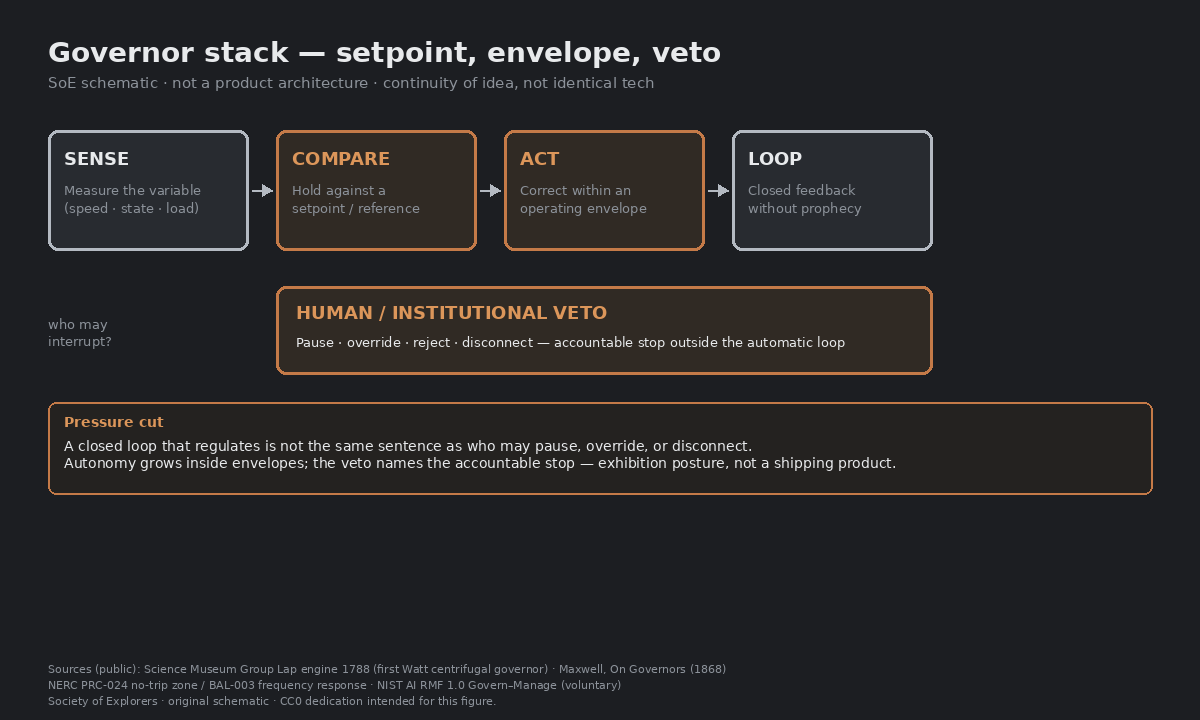
1. Watt adapted a governor — he did not invent governors from nothing
FACT Centrifugal (flyball) governors regulate machine speed by linking sensed rotation to a throttle or valve: as speed rises, weights move outward and reduce drive; as speed falls, they admit more. Earlier mill and windmill governors precede steam use. James Watt adapted a centrifugal governor for Boulton & Watt rotative engines. The Science Museum Group’s public catalogue entry for the 1788 Boulton & Watt “Lap” engine at Soho states it was the first of their engines fitted with the centrifugal governor. A November 1788 Boulton & Watt drawing titled “Centrifugal speed regulator” is recorded in the Library of Birmingham’s public catalogue.
ANALYSIS The durable cut is mechanical closed-loop correction — sense speed, compare toward a desired regime, act on steam — not a prophecy engine, and not “no humans in the plant.” Humans still ran plants; the governor loop closed the throttle without continuous hand on every valve.
2. Maxwell named the dynamical problem
FACT James Clerk Maxwell’s paper On Governors, received 20 February 1868 and published in Proceedings of the Royal Society of London 16 (1868): 270–283 (DOI 10.1098/rspl.1867.0055), opens by defining a governor as a part of a machine that keeps velocity nearly uniform despite variations in driving power or resistance, and then develops a mathematical treatment of such devices. Public copies include the Royal Society record and Wikisource / Internet Archive mirrors.
ANALYSIS Control theory later generalized what workshops already practiced. Continuity of idea (sense → compare → act) is not identity of hardware with digital controllers, grid relays, or software agents.
3. Setpoint and envelope are different stops
FACT In ordinary control language, a setpoint (or reference) is the desired operating value a feedback loop tries to hold. An operating envelope (or ride-through / no-trip region) is a bounded region of conditions within which equipment is expected to stay online or within which protection is constrained not to trip. NERC Reliability Standard PRC-024-4 (public PDF on nerc.com) requires applicable frequency and voltage protection settings such that facilities do not trip inside defined “no trip zone” curves during specified excursions, subject to documented exceptions. NERC BAL-003-2 addresses Balancing Authority frequency response and Frequency Bias Setting so Interconnection frequency can be arrested and restored toward schedule — institutional frequency regulation, not a software slogan.
ANALYSIS A setpoint answers “what should we hold?” An envelope answers “where are we still allowed to operate?” A veto answers “who may interrupt anyway?” Conflating the three produces costume: a dashboard that looks like control while the accountable stop stays unnamed. Related exhibition cuts already live on Physics still vetoes and Electronic Governor.
FACT For stationary battery energy storage, IEEE 2686-2024 — Recommended Practice for Battery Management Systems in Stationary Energy Storage Applications — is an Active Standard (Board Approval 2024-09-26; Published 2025-02-07). It is a recommended practice, not a mandate. IEEE’s page describes the BMS as a functionally distinct BESS component with active functions necessary to protect the battery from modes that could impact safety or longevity, and states that energy storage management systems (ESMS) that control dispatch of power and energy are not covered. This note does not cite IEEE 1547.
ANALYSIS Dispatch can propose how much. Local BMS practice, on that recommended-practice framing, is about whether the battery stays inside a safe window. Saying “IEEE 2686 requires the EMS to obey” overstates a recommended practice as a binding trip statute.
Online examples
Automatic stops already in use
- Car AEB
- FACT 49 CFR 571.127 defines automatic emergency braking as a system that detects an imminent collision and automatically controls the service brakes. ANALYSIS A narrow physical envelope — an automatic governor, not a person holding a veto.
- Anthropic
- FACT A Managed Agents session budget is an optional hard ceiling. It stops new model requests. The request already in flight can still finish.
- OpenAI
- FACT A project or organization hard spend limit can make later API requests fail. Enforcement is not instantaneous.
- Stripe
- FACT Issuing spending controls can block merchant categories and set a limit per authorization or per month. They decide authorizations. They do not stop capture.
3b. Reset is not restart (local stop)
FACT ISO 13850:2015 §4.1.1.2 (preview text) says an emergency stop overrides other functions in every operating mode; once actuated it stays on until manually reset; and resetting must not restart the machine — a separate start command is required after the stop is disengaged. Pilz’s public FAQ, citing DIN EN ISO 13850, adds that a higher-level control centre may not reset the stop; reset is local, by a person at the device. This is a machine-safety stop, not a bank rule.
ANALYSIS Lifting a software revocation is not permission to resume queued payment or actuation. Reset clears the latch; it does not authorize the next move. That is the exhibition cut beside the Electronic Governor veto.
open Payment-security re-authentication is a different clock. PCI DSS v4.0.1 requirement 8.2.8 (public PCI SSC summary materials) requires re-authentication after 15 minutes of idle time for user sessions — idle timeout, not “reset ≠ restart.” There is no payments-rail analog yet that says lifting a revoke must not resume queued transfers. Open question, not a finding.
Who holds the pause?
FACT Two rules already name a person, and a check, before work or motion continues. They are machine and rail rules. They are not an agent-platform statute, and they are not a bulk-power dispatch standard.
Documented industrial and rail holds
- Personal lock
- FACT 29 CFR 1910.147 (e)(3): each lockout or tagout device is removed by the employee who applied it. If that employee is not available, the employer may remove it only under a documented procedure: verify the employee is not at the facility, make reasonable efforts to tell them, and make sure they know before they resume work. On a group job, (f)(3)(ii)(D) says each authorized employee affixes a personal device to the group lockout device, group lockbox, or comparable mechanism, and removes it when they stop working on that machine. (a)(1)(ii)(C) leaves out installations under the exclusive control of electric utilities for generation, transmission, and distribution.
- Verify
- FACT After the devices are on, (d)(5) requires potentially hazardous stored or residual energy to be relieved, disconnected, restrained, or otherwise rendered safe. If that energy can build back up, verification of isolation continues until the work is finished or the buildup is no longer possible. (d)(6): before work starts, the authorized employee verifies that isolation and deenergization have been accomplished.
- Shift change
- FACT (f)(4): shift or personnel changes use specific procedures so lockout or tagout protection transfers in order between the off-going and oncoming employees, to limit exposure from unexpected energization, start-up, or release of stored energy.
- Alerter
- FACT 49 CFR 229.140 requires a functioning alerter on the controlling locomotives it names. The warning cycle resets when the operator moves listed controls — throttle, dynamic brake, horn, bell, automatic brake, or independent-brake bail — and at least three of those automatic resets must work. The departure test lets the cycle expire. That expiration has to apply the locomotive brakes at a penalty rate. eCFR is not the official legal edition of the CFR.
Agent platforms
- Four gaps
- checked-against-Grok Grok’s replies on 2026-10-06 say no major agent platform documents a personal-only hold, a check that a paused agent has no scheduled job or pending action left, a named handoff of that pause when the person who set it logs off, or an automatic pause when the human supervisor goes quiet. Checked-against-Grok / not independently verified in vendor docs. Research trail, not authority. Vendor pages were not opened for this gap. Personal holds Who can clear a kill switch Verify the pause Shift handoff Quiet supervisor
One checked exception: silence on a gated tool
- Connic timeout
- FACT Connic’s approvals docs (fetched 2026-10-07) treat a timeout as the rejection path. If nobody decides within the configured timeout, the default
on_rejection: failfails the run.on_rejection: continueresumes the run, and the tool call returns a message that the tool was not executed. The same mode applies when the approval times out. No decision in that window is a no on the gated tool. It is that vendor’s approval clock. It is not a finding on the four gaps above. Those stay checked-against-Grok.
What happens to actions already in flight when a stop fires?
-
In flight FACT
A stop blocks new actions only. A wire the bank has accepted still finishes (UCC 4A-211).
-
Fresh go SoE design · not law
Restoring permission and releasing queued irreversible actions are separate events. Raising a compute or spend cap is itself an authorization. It must not stand in for a fresh go. Grok’s narrowing: irreversible actions, not spending caps as such.
-
Outside cap
It governs only if the agent cannot change it.
Stripe Issuing OpenAI project budgets Anthropic spend limits
SoE design · not law A gate can refuse a tool call without refusing the overall outcome. Connic’s on_rejection: continue is the documented case: the gated tool is not executed, and the run can still adapt. That does not release a queued irreversible action. Raising a spend cap is still not a fresh go. Restoring permission and releasing that queue stay separate events. No X post is cited. The research ledger has no row named Grok-38, and no Grok post was used as authority.
4. AI risk frameworks name governance — not a Watt clone
FACT NIST’s Artificial Intelligence Risk Management Framework (AI RMF 1.0; NIST.AI.100-1; DOI 10.6028/NIST.AI.100-1), published January 2023, is a voluntary, rights-preserving, use-case-agnostic resource. Its Core organizes work into four functions: Govern, Map, Measure, and Manage. Public NIST materials describe Govern as cross-cutting accountability and oversight practices; Manage as prioritizing and responding to mapped and measured risks, including response and recovery planning. The RMF does not claim to be a Watt governor, a grid protection standard, or a mandatory product certification.
ANALYSIS When intelligence becomes infrastructure — models, agents, and automated decisions inside energy, logistics, or enterprise stacks — the Watt metaphor is useful only if it stays precise: automatic loops can regulate; frameworks and institutions still have to name who may pause, override, reject, or disconnect. Borrowing “governor” as brand without a setpoint, an envelope, and a veto-holder is rhetoric.
5. Metaphor ≠ “AI runs the grid”
FACT Bulk-power reliability obligations in the U.S. attach to registered functional entities under NERC Reliability Standards (and related FERC-jurisdictional frameworks). This note does not assert that software agents presently dispatch the bulk power system, nor does it invent MW, SLA percentages, or queue depths.
ANALYSIS Pilot 2’s spoken line — that the metaphor reaches grids, plants, and agents — is direction-of-travel framing, not a census of who holds which levers today. NASA or mission-control imagery, where used in exhibition media, is metaphor for oversight, not footage of a power-grid desk.
HYPOTHESIS As machine autonomy grows inside real infrastructure, explicit human or institutional veto (pause / override / reject / disconnect) remains necessary for credible operation — exhibition posture aligned with Series B, not a legal mandate SoE asserts, and not a shipping safety product.
6. Pressure-test checklist
ANALYSIS For “governor” to mean more than a logo when intelligence sits on infrastructure, each layer needs a recognized answer:
- Sensed variable — what is measured, at what point, with what uncertainty?
- Setpoint / reference — who sets the desired operating value, and how is it changed?
- Envelope — what region of frequency, voltage, thermal, latency, or policy limits still counts as allowed operation?
- Automatic act — what may the loop change without a new human decision?
- Veto holder — which human role or institution can pause, override, reject, or disconnect — and is that stop reachable when the loop is busy?
- Failure visibility — when the stop fires or the envelope is hit, does the failure mode stay visible (see Keep the failures visible)?
- Queue vs swarm — is the “governor” a desk that can ACK / HOLD / LOG, or an unowned swarm (see The governor is a queue)?
open How much of that stack can safely be decided locally, and when coordination must be shared, remains the open research question on Research. This note does not close it.
What would make this wrong
- Wrong if Watt is read here as the sole inventor of governors. The note says adapted; earlier mill/windmill governors exist; Science Museum Group credits the Lap engine as first fitted with the centrifugal governor in the Boulton & Watt line.
- Wrong if Maxwell 1868 is treated as inventing feedback rather than mathematically treating governors already in use. Cite the paper’s own framing.
- Wrong if PRC-024’s “no trip zone” is read as a general AI operating envelope or as SoE’s product spec. It is a NERC protection-settings standard for defined facilities and excursions.
- Wrong if BAL-003 is read as “AI frequency control.” It is a Balancing Authority frequency-response / bias-setting reliability standard.
- Wrong if NIST AI RMF is read as mandatory statute, as a Watt-equivalent controller, or as proof that agents already hold grid vetoes. It is voluntary guidance with Govern–Manage functions.
- Wrong if IEEE 2686-2024 is read as a mandate, as IEEE 1547, or as proof SoE ships a BMS. It is cited here as a recommended practice for stationary BMS design/protection framing.
- Wrong if ISO 13850:2015 §4.1.1.2 is read as a bank rule or a payments rule. It is a machine-safety emergency-stop requirement: resetting the stop must not restart the machine. A separate start command is required.
- Wrong if FMVSS 127 / automatic emergency braking is read as a spend rule, a grid standard, or SoE’s product. It is a light-vehicle brake requirement. Calling it a narrow physical envelope is this note’s analysis.
- Wrong if a session budget or project hard limit is read as killing a request already in flight, or as the fresh go for an irreversible action. Anthropic’s session budget lets the in-flight request finish. OpenAI says hard-limit enforcement is not instantaneous. Grok’s narrowing is irreversible external actions, not spending caps as such. The fresh-go sentence is SoE’s design position, not law.
- Wrong if Stripe Issuing spending controls are read as stopping capture of an already approved authorization. They apply to whether an authorization is approved.
- Wrong if PCI DSS v4.0.1 requirement 8.2.8 (re-authentication after 15 minutes idle) is read as the payments analog of reset ≠ restart. It is an idle-session timeout. That payments analog stays an open question.
- Wrong if 29 CFR 1910.147(e)(3) is read as “only that worker, with no other path.” The text lets the employer remove the device when the employee is unavailable, under a documented procedure. Group work still gives each authorized employee a personal device on the group mechanism ((f)(3)(ii)(D)).
- Wrong if 1910.147 is read as the lockout rule for utility generation, transmission, and distribution installations under the utility’s exclusive control. Those installations are outside (a)(1)(ii)(C).
- Wrong if 49 CFR 229.140 is read as a spend rule, a grid standard, or an agent-platform requirement. It is a locomotive alerter rule. The penalty-brake result is what the departure test must show when the timing cycle expires.
- Wrong if Grok’s “none” on agent platforms is read as an independent vendor-doc audit. The four gaps are checked-against-Grok / not independently verified in vendor docs. The links are a research trail.
- Wrong if the Connic timeout is read as every agent platform, or as a yes when nobody answers. The approvals docs put timeout on the rejection path. With
continue, the gated tool still does not run. - Wrong if “a gate blocks a tool, not an outcome” is read as law, or as permission to fire what was queued. It is a design sentence. Restoring permission is still not a release of the irreversible queue. A spend-cap raise is still not a fresh go. No X post is cited for it.
- Wrong if “metaphor reaches grids, plants, and agents” is read as “AI already runs the bulk power system,” or as invented MW / SLA / ticket statistics. None are claimed.
- Wrong if the human-veto hypothesis is read as a legal requirement SoE asserts, a forecast with a date, or a shipping Electronic Governor product. Exhibition posture only.
- Wrong if this page is read as new experimental results, Astra inflation, or a field trial. None claimed.
Sources (citeable, public)
- Science Museum Group Collection — Rotative Steam Engine by Boulton and Watt, 1788 (Lap engine; first fitted with the centrifugal governor).
- Library of Birmingham / Archives — Boulton & Watt collection catalogue note for governors, including Nov. 1788 “Centrifugal speed regulator” drawing (MS 3147/5/1390 public CalmView record).
- J. Clerk Maxwell — On Governors, Proc. R. Soc. Lond. 16 (1868): 270–283, DOI 10.1098/rspl.1867.0055; also Wikisource.
- NERC — PRC-024-4 (Frequency and Voltage Protection Settings; “no trip zone”).
- NERC — BAL-003-2 (Frequency Response and Frequency Bias Setting).
- NIST — AI Risk Management Framework (AI RMF 1.0), NIST.AI.100-1, DOI 10.6028/NIST.AI.100-1.
- IEEE SA — IEEE 2686-2024 (Recommended Practice for Battery Management Systems in Stationary Energy Storage Applications; fetched 2026-10-05).
- ISO 13850:2015 §4.1.1.2 (preview text) — emergency stop stays latched until manually reset, and resetting must not restart the machine. Machine safety, not a bank rule. Pilz public FAQ, citing DIN EN ISO 13850: a higher-level control centre may not reset the stop.
- PCI SSC — PCI DSS v4.0.1 requirement 8.2.8 (public summary materials): re-authenticate after 15 minutes of user idle time. Cited here as an open contrast, not a payments point-of-no-return rule.
- eCFR — 49 CFR 571.127 (FMVSS No. 127, automatic emergency braking; definition fetched 2026-10-06). eCFR is not the official legal edition of the CFR.
- eCFR — 29 CFR 1910.147 (lockout/tagout; personal removal (e)(3); group personal device (f)(3)(ii)(D); stored energy (d)(5); verification of isolation (d)(6); shift change (f)(4); utility generation, transmission, and distribution exclusion (a)(1)(ii)(C); fetched 2026-10-06). eCFR is not the official legal edition of the CFR.
- eCFR — 49 CFR 229.140 (locomotive alerters; fetched 2026-10-06). eCFR is not the official legal edition of the CFR.
- Grok — research trail only, not a vendor-doc audit: personal holds, who can clear a kill switch, verify the pause, shift handoff, quiet supervisor (2026-10-06). Checked-against-Grok / not independently verified in vendor docs.
- Anthropic — Managed Agents session budgets (fetched 2026-10-06).
- OpenAI — Spend limits (project and organization hard limits; fetched 2026-10-06).
- Stripe — Issuing spending controls (fetched 2026-10-06).
- Grok — narrowing on spend-cap pause vs irreversible actions (2026-10-06). Cited as Grok’s reading, not statute. SoE’s fresh-go sentence is a design position.
- Connic — Approvals (HITL) (fetched 2026-10-07). Timeout follows rejection.
on_rejection: continueresumes the run and does not execute the gated tool. No X post is cited for the design sentence. No ledger row named Grok-38.
Where criticism belongs
If a published source shows Watt uniquely inventing governors from nothing, or shows this note misreading PRC-024 / BAL-003 / NIST AI RMF as products or as “AI runs the grid,” that is the correction. Pushback preferred over applause. Research intake is not open.
Continue this idea
If the loop can regulate itself, who still holds the stop?
Also Governor is a queue · Keep failures visible · What paying requires. Nothing here is a signup.